Alexander Pope: A Literary Titan Misunderstood in His Age Yet Revered Through Time
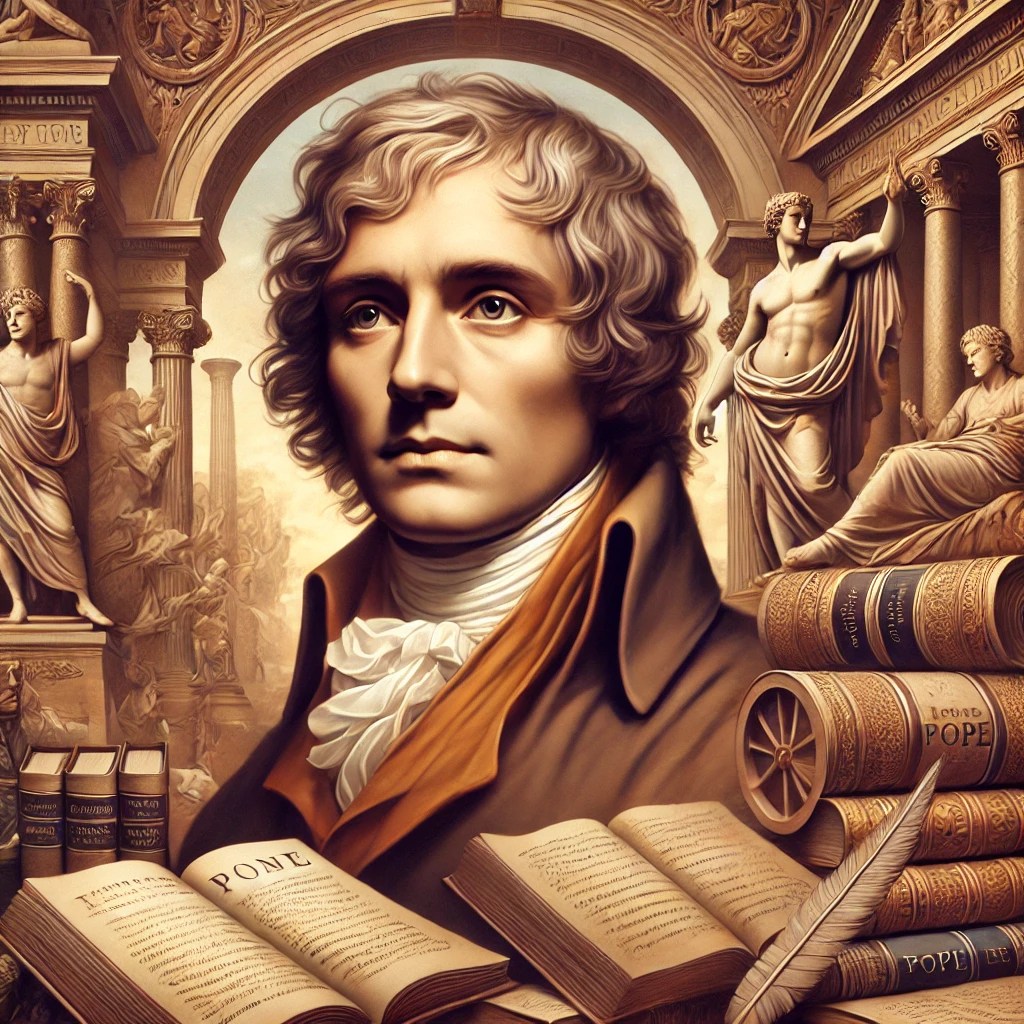
Introduction to Alexander Pope

Alexander Pope, an 18th-century English poet, stands as one of literature’s great satirists, yet his life was marked by considerable personal and professional challenges. The idea that “Pope was great, but not in his age” speaks to the dichotomy of Pope’s legacy: while admired by some, he was also subject to severe criticism. His biting wit and distinctive satirical style drew both praise and disdain from contemporaries. Religious limitations, societal bias, and health struggles all shaped Pope’s career. This article explores how, despite these hurdles, Pope’s literary genius was ultimately recognized after his time, with a reputation that grew as later critics and writers acknowledged his mastery of language, satire, and moral reflection.

Early Life and Education

Born in London in 1688 to a Catholic family, Pope grew up amid significant restrictions. Catholics faced harsh discrimination in England, limiting Pope’s access to formal education and career opportunities. As a result, he became a largely self-taught scholar, immersing himself in the works of classical poets like Homer, Virgil, and Ovid. This early passion for classical literature molded his poetic style, grounding it in the traditions of Neoclassicism. Yet, his health presented another challenge; a severe form of tuberculosis left Pope with lifelong physical ailments. These difficulties isolated him but also spurred his drive to make an indelible mark on English literature, a goal he would achieve with vigor and resilience.

The Landscape of 18th-Century English Literature

Pope’s rise occurred in a period when Neoclassicism, which stressed order and reverence for the classics, dominated English literature. Satire emerged as a preferred tool for examining social issues, with writers like John Dryden and Jonathan Swift critiquing their world through wit and irony. Pope became a leading figure in this satirical movement, blending classical influences with contemporary commentary. His Catholic background, physical condition, and lack of noble connections, however, distinguished him from his peers. These characteristics, combined with his intellect, positioned him as a unique voice in English letters. Pope’s perspective allowed him to both critique and emulate his contemporaries, solidifying his status as a transformative force in literature.

Pope’s First Success: Pastorals and An Essay on Criticism

Pope’s initial foray into literature began with Pastorals (1709), which gained him early attention for its use of classical forms to depict rural life. His true breakthrough came with An Essay on Criticism (1711), a work that presented his thoughts on poetry and criticism in eloquent, memorable language. The poem, penned in heroic couplets, combines insights into art with satirical observations on literary critics, showcasing Pope’s unique talent for blending philosophy with poetic elegance. Famous lines like “To err is human; to forgive, divine” highlight Pope’s capacity for capturing timeless truths. This success, though, also brought Pope new detractors, who saw his youthful ambition as audacious. Nevertheless, An Essay on Criticism established Pope’s voice in English letters.

Satire and Social Critique in The Rape of the Lock

Pope’s The Rape of the Lock (1712) remains one of his most acclaimed works, using mock-epic style to satirize the vanities of aristocratic society. The poem tells the humorous tale of a quarrel over a stolen lock of hair, which Pope presents in the grand style of Homeric epic, amplifying the absurdity of high-society customs. This mix of “high” and “low” style offered readers a critique of trivial conflicts while paying homage to classical epic tradition. Pope’s satirical wit struck a chord with readers, but it also sparked controversy. While some viewed it as lighthearted fun, others found the critique of upper-class pretensions biting. The Rape of the Lock affirmed Pope’s skill at merging humor and social critique, helping to establish satire as his trademark.

Political and Religious Constraints

Pope’s Catholic faith imposed significant limitations on his career. England’s Protestant establishment barred Catholics from many professions and social privileges, which hindered Pope’s public prospects. Lacking access to patronage, he relied heavily on the sale of his books, a unique approach that allowed him financial independence uncommon among writers of his time. His works often reflected a sense of exclusion and a critical view of established norms. Pope’s satire, at times, became his shield and his weapon, allowing him to critique the power structures and conventions of his era without directly attacking individuals. This balancing act was essential to his survival and success in a society often hostile to his faith and views.

Pope’s Major Work: The Dunciad

The Dunciad (1728) represents Pope’s most scathing critique of mediocrity in literature and society. Targeting individuals he deemed representatives of “dullness,” the poem ridicules the shallow writers and critics who, in Pope’s view, sullied the literary field. By portraying them as servants of the goddess Dulness, Pope calls into question the very quality of English letters in his day. This harsh satire earned him numerous enemies, and his targets included prominent figures like Colley Cibber and Joseph Addison. Although divisive, The Dunciad showcased Pope’s mastery of satire and solidified his role as a critic of society’s intellectual failings, cementing his place as an uncompromising force in English literature.

Moral Philosophy in An Essay on Man

In An Essay on Man (1733-1734), Pope delves into questions of existence, ethics, and human nature, exploring humankind’s place within the universe. The work’s central line, “Whatever is, is right,” embodies a philosophical optimism, reflecting the belief in a harmonious, divinely ordered world. Written in heroic couplets, the poem grapples with the balance between human imperfection and universal design. Pope’s approach was influenced by Enlightenment ideas, though the poem was critiqued for its idealism. Despite mixed reactions, An Essay on Man resonated with thinkers across Europe and became one of Pope’s most widely read works, influencing both philosophical and literary discourse well beyond his time.

The Challenge of Literary Fame in His Lifetime

Pope’s fame did not shield him from personal attacks and public criticism. His satirical barbs in works like The Dunciad invited hostility from literary rivals and public figures. These adversaries questioned his intentions and accused him of being overly ambitious, especially as he defended his reputation vigorously. In response, Pope often addressed his critics through satirical poetry, reinforcing his position as a fiercely independent voice. By the end of his life, however, he saw a decline in popularity as other literary trends emerged. Nevertheless, Pope’s contributions were undeniable, and his self-assertive approach to fame reflected his unyielding commitment to his vision and principles.

Pope’s Legacy and Influence on Later English Literature

Though Pope’s career was marked by controversy, his influence only grew after his death. Romantic poets, including Byron, Wordsworth, and Shelley, admired his mastery of language and satirical wit, even as they diverged from his formal style. His use of the heroic couplet left a lasting mark on English poetry, while his philosophical and moral writings continued to provoke thought among readers and critics. Over time, literary scholars recognized Pope’s contributions to both poetic form and social commentary. His works became subjects of admiration and study, underscoring how his fame only increased after his time, with his legacy recognized as one of skill, resilience, and cultural insight.

Conclusion: Pope’s Reception and Enduring Legacy

In reflecting on Pope’s journey, it becomes evident that his life embodied the idea of being “great, but not in his age.” While admired by some in his time, it took years for his genius to gain full appreciation in the literary world. Pope’s ability to confront societal shortcomings, blend humor with philosophy, and wield the English language with precision has cemented his place among the literary greats. His career exemplifies how true brilliance often requires the lens of history to be fully appreciated, with his influence enduring long after his era. Alexander Pope’s legacy serves as a testament to the power of the written word, enduring beyond the limitations of time and circumstance.

Poetic Truth in English Literature: An Exploration

Introduction

Poetic truth is a concept that has been central to the discourse of literature and art for centuries. Unlike the literal truth that is grounded in factual accuracy, poetic truth is about capturing the essence, the deeper emotional and existential truths of the human experience. This concept holds a significant place in English literature, where poets and writers strive to unveil the deeper layers of reality through imaginative and often symbolic representation.

Historical Background

The idea of poetic truth can be traced back to ancient philosophical debates, notably among the Greeks. Plato criticized poetry for its capacity to mislead and distort reality, yet he also acknowledged its potential to reveal deeper truths. Aristotle, in his “Poetics,” argued that poetry is more philosophical and higher than history because it deals with universals, whereas history deals with particulars. This foundational argument set the stage for the enduring tension between literal and poetic truth.

Poetic Truth in the Renaissance

The Renaissance was a period of flourishing arts and a renewed interest in classical philosophy, where the notion of poetic truth gained significant traction. Edmund Spenser’s “The Faerie Queene” epitomizes the Renaissance pursuit of moral and philosophical truth through allegory. Spenser’s epic poem is not merely a fantastical narrative; it is a profound exploration of virtues, human nature, and the moral struggles of life. The allegorical figures and landscapes he creates serve to illuminate truths about human existence and ethical ideals in ways that factual recounting cannot.

Romanticism and the Expansion of Poetic Truth

The Romantic era marked a dramatic shift towards emphasizing individual perception and emotional depth as core components of poetic truth. William Wordsworth’s preface to “Lyrical Ballads” is a seminal text in this regard. Wordsworth championed the idea that poetry should capture the “spontaneous overflow of powerful feelings” and that the poet’s role is to convey the beauty and sublimity of nature and human experience. His works, such as “Lines Composed a Few Miles Above Tintern Abbey,” exemplify this pursuit of poetic truth by delving into the profound emotional and spiritual responses elicited by nature.

Samuel Taylor Coleridge, another pivotal figure of Romanticism, further expanded on this idea. In his “Biographia Literaria,” Coleridge introduced the concept of the “willing suspension of disbelief.” He suggested that poetic truth involves a blend of imagination and reality, where readers accept the fantastical elements of a narrative because they reveal deeper truths about the human condition. Coleridge’s “The Rime of the Ancient Mariner” embodies this, using supernatural events to explore themes of guilt, redemption, and the interconnectedness of all life.

Victorian Era and Realist Concerns

The Victorian era brought a more complex interplay between poetic truth and realism. While poets like Alfred Lord Tennyson and Robert Browning continued to explore profound truths through their work, there was also a growing emphasis on social realities and the human psyche. Tennyson’s “In Memoriam A.H.H.” is a poignant exploration of grief and faith, where the poetic truth lies in its deep emotional resonance rather than mere factual recounting of events.

Robert Browning’s dramatic monologues, such as “My Last Duchess” and “Porphyria’s Lover,” delve into the psychological depths of their characters, offering insights into human motivations and moral complexities. These works showcase how poetic truth can reveal the inner workings of the mind and soul, often presenting a reality that is more penetrating than external appearances.

Modernism and Beyond

The Modernist movement further revolutionized the concept of poetic truth. T.S. Eliot, in his essay “Tradition and the Individual Talent,” argued for the objective correlative, where emotions are expressed through a set of objects, situations, or events that evoke a particular response. Eliot’s “The Waste Land” is a masterful example, using fragmented imagery and a collage of voices to depict the disintegration and potential renewal of post-World War I society. The poem’s truth lies in its ability to capture the chaotic and fragmented nature of modern life.

Similarly, W.B. Yeats’ poetry often blends myth, history, and personal experience to reveal deeper truths about the human condition. His work “The Second Coming” reflects on the cyclical nature of history and the tension between destruction and creation, capturing profound existential and historical truths.

Conclusion

Poetic truth in English literature is a multifaceted concept that transcends mere factual accuracy to explore deeper emotional, psychological, and philosophical truths. From the allegorical landscapes of the Renaissance to the emotional depths of Romanticism, the psychological insights of the Victorian era, and the fragmented realities of Modernism, English literature is rich with examples of how poetic truth provides a unique lens through which to understand the complexities of human experience. This enduring quest for deeper understanding through imaginative and symbolic representation continues to shape and define the landscape of English literature.

Unveiling the Dark Depths of Passion: A Critical Exploration of Emily Brontë’s Wuthering Heights

Welcome, literature enthusiasts, to another insightful journey into the world of classic literature. In this episode, we delve into the enigmatic realms of Emily Brontë’s masterwork, “Wuthering Heights.” This timeless novel stands as a testament to Brontë’s unparalleled ability to capture the intricacies of human nature and the destructive force of unbridled passion.

1. Gothic Elements and Atmosphere: “Wuthering Heights” is a masterpiece of Gothic literature, weaving a haunting tapestry of desolate moors and eerie landscapes. Brontë’s atmospheric prowess sets the stage for the unfolding drama, enveloping the reader in an unsettling ambiance that mirrors the tumultuous emotions of the characters.

2. Character Dynamics and Psychological Depth: The characters in “Wuthering Heights” are complex and deeply psychological, defying conventional norms. Heathcliff, Catherine Earnshaw, and their tumultuous relationship showcase Brontë’s keen understanding of the human psyche. The novel’s exploration of obsession, revenge, and unrequited love adds layers of depth to its characters.

3. Narrative Structure: Brontë employs a unique narrative structure, presenting the story through a series of nested accounts. The use of multiple narrators adds an intriguing layer of subjectivity, inviting readers to question the reliability of the storytellers. This narrative complexity contributes to the novel’s enigmatic charm.

4. Themes of Love and Revenge: At its core, “Wuthering Heights” is a tale of love and revenge, entwining these themes in a narrative dance that spans generations. Brontë’s exploration of the destructive power of love gone awry and the cyclical nature of vengeance leaves an indelible mark on the reader’s consciousness.

5. Social Commentary: Beyond its romantic and Gothic elements, “Wuthering Heights” offers a subtle commentary on societal norms and expectations. The novel challenges the constraints of class and social hierarchy, presenting a stark portrayal of the consequences of societal repression.

Conclusion: In conclusion, Emily Brontë’s “Wuthering Heights” stands as a literary tour de force, inviting readers to confront the darker aspects of human nature. From its Gothic atmosphere to its complex characters and profound themes, the novel continues to captivate and mystify audiences. Join us in the exploration of this timeless classic that transcends the boundaries of conventional storytelling.

Alliteration: The Art of Sound in Language

Language is a tapestry of sounds, rhythms, and patterns that can be as mesmerizing as a musical composition. Among the many tools at the disposal of writers and poets, alliteration stands out as one of the most captivating and evocative. This literary device, marked by the repetition of consonant sounds at the beginning of nearby words, weaves a symphony of words that can captivate the ear and engage the mind. In this article, we will explore alliteration in depth, examining its forms, functions, and the profound impact it has had on English literature.

Understanding Alliteration: Alliteration, derived from the Latin word “alliteratio,” is a literary device that has been used for centuries to create aural pleasure and poetic resonance. It occurs when two or more words in close proximity begin with the same consonant sound, creating a pleasing rhythm and musical quality in the language. For example, consider the famous line from William Shakespeare’s “Macbeth”: “Fair is foul, and foul is fair.” The repetition of the “f” sound in “fair” and “foul” not only creates a memorable phrase but also contributes to the eerie and mysterious tone of the play.

Forms of Alliteration: Alliteration comes in various forms, each with its unique characteristics:

1. Consonance: This form of alliteration involves the repetition of consonant sounds anywhere within words, not just at the beginning. For instance, “fuzzy wuzzy” showcases consonance with the repeated “z” sound.

2. Assonance: Assonance is the repetition of vowel sounds within words. It often creates a harmonious and rhythmic effect. For example, consider the assonance in Edgar Allan Poe’s “The Raven”: “deep into that darkness peering.”

3. Sibilance: Sibilance focuses on the repetition of hissing or hissy “s” or “sh” sounds, adding a sense of softness or even tension to the language. A famous example can be found in Samuel Taylor Coleridge’s “The Rime of the Ancient Mariner”: “The serpentine silentness sailed.”

The Functions of Alliteration: Alliteration serves several important functions in literature:

1. Emphasis: Alliteration draws attention to specific words or phrases, making them stand out and emphasizing their significance within a text.

2. Sound and Rhythm: It creates a pleasing musical quality in the language, enhancing the text’s auditory appeal and contributing to its overall rhythm and flow.

3. Memorability: Alliterative phrases are often more memorable, making them easier for readers to recall and quote.

4. Tone and Mood: Alliteration can set the tone and mood of a piece, whether it’s through soft, soothing sounds or sharp, jarring ones.

5. Imagery and Atmosphere: Through its rhythmic patterns, alliteration can help create vivid imagery and establish a particular atmosphere or ambiance.

Examples of Alliteration in Literature: Alliteration has graced the pages of countless literary works, enriching them with its melodic charm. Here are a few iconic examples:

1. The Raven by Edgar Allan Poe: “And the silken, sad, uncertain rustling of each purple curtain.”

2. Beowulf (Anonymous Old English Epic): “So times were pleasant for the people there until finally one, a fiend out of hell…”

3. Tongue Twisters: Alliteration’s playful side is often found in tongue twisters like “She sells seashells by the seashore.”

To conclude, alliteration is more than just a linguistic ornament; it’s a powerful tool in the writer’s arsenal. It enhances the auditory experience of language, engages the reader or listener on a deeper level, and leaves an indelible mark in the memory. Whether used to create mood, emphasize ideas, or simply delight the ear, alliteration is a testament to the artistry and versatility of language in literature. It is a reminder that words, when skillfully woven, can create a symphony of sound that resonates long after the reading is done.